Emmi and Leo’s Café Huber recognition game
Love VirtuallyEmmi and Leo’s Café Huber recognition game is a proposed face-to-face encounter designed to preserve uncertainty rather than resolve it. Leo suggests that each should try to identify the other in a crowd without making contact or confirming the result. The game briefly brings their email intimacy within reach of the physical world, but its rules keep recognition—and the reality it might disclose—deliberately unsettled.
Origins and Rules
The proposal follows Leo’s recognition that Emmi wants to know what he looks like. He turns that curiosity into an experiment: among twenty women, he believes he could identify the one and only Emmi Rothner, while she would not be able to pick out Leo Leike from a comparable group of men. The wager is not simply about appearance. It tests whether the person assembled through emails can be recognized in a room full of strangers.
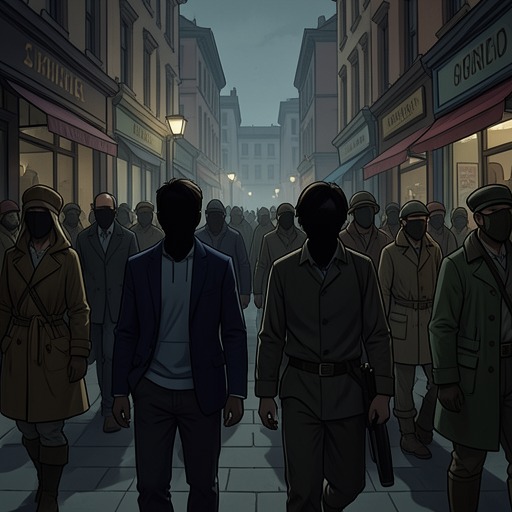
Leo proposes Huber, the large café on Ergelstrasse, as a venue with a mixed crowd and steady movement. They could choose a two-hour window on a Sunday afternoon and remain among the other customers, so their search would not draw attention. The public setting allows both to be physically present while withholding the usual signs of a meeting: an introduction, an agreed description, or an exchange that would confirm who has been found.
The rules also limit what the encounter can settle. Leo suggests that even after the game they might not reveal what either actually looks like. What matters, in his formulation, is whether one of them thinks they have recognized the other, not whether they verify the match. He says that he wants to recognize Emmi rather than know her appearance, and adds that his earlier imagined picture of her has changed. That distinction gives the game its peculiar intimacy: recognition is treated as an act of interpretation, while confirmation is withheld.
Resistance and the Decision to Play
Emmi initially pulls away from the correspondence, describing it as far removed from real life. Her skiing holiday, despite its irritations, belongs to the ordinary world she knows; by contrast, she calls herself a fantasy image to Leo and describes their exchange as a way to experience the first stages of an affair without having one. She sees their connection as an affair that cannot happen and argues that they should stop before it becomes ridiculous. Her message makes the proposed game more than a flirtatious diversion: it arrives against a stated wish to end the relationship.
Leo answers by asking whether they can at least play the recognition game, suggesting that the experiment might make it easier to break off their impossible affair. He acknowledges that ending the emails would not end his thoughts of Emmi, and presents the meeting as a way to give their unfinished connection some form. The proposal therefore carries two opposed purposes: it promises a glimpse of the person beyond the screen, yet is offered as preparation for separation rather than as a step toward an acknowledged relationship.
The exchange also establishes a tension between their different claims on reality. Emmi emphasizes that Leo knows her only through letters and that her family life is real; Leo, by contrast, seeks a limited encounter that does not demand disclosure. Their game offers neither full immersion in domestic life nor a conventional meeting. It creates a narrow middle ground in which each can look for the other and still preserve the protective distance of the correspondence.
The Café Search and Its Uncertain Result
Three days after the planning exchange, Emmi sends a brief message asking Leo whether he was there. The question records that the proposed search has taken place, or at least that Emmi has gone looking for him at the appointed opportunity. It does not establish that they found one another, that either recognized the other, or even that both experienced the same outcome. The exchange leaves the central test unresolved rather than supplying a verified identification.
Leo’s later account shows that he observed and classified women in the café in considerable detail. He offers three possible Rothner candidates, beginning with an “Ur-Emmi” at the bar, fourth from the left, and then describing a blonde alternative who changes seats and spends time at the bar. His inventory includes clothing, movement, approximate age and height, drinks, and manner. The specificity makes his search seem confident, but the multiple candidates expose its uncertainty: he can construct vivid possible Emmis without demonstrating which, if any, is Emmi.
When a candidate is identified as Leo’s sister, Emmi’s immediate response is, “That’s my sister!” She then explains that the sister’s presence was only a cover: Emmi spent the whole time looking at women and describing potential Emmis in minute detail. The reversal reveals that the observers’ apparent roles were not what they seemed. Leo’s sister served as a decoy or cover, while Emmi herself was engaged in the same kind of searching and interpretation that Leo’s later catalogue makes visible. The game thus produces a correspondence between their methods, not a confirmed recognition between the two players.
What the Game Reveals—and Withholds
The recognition game becomes a miniature version of the larger relationship. Leo’s descriptions turn strangers into possible versions of Emmi, while Emmi’s account shows her similarly scanning the women around her. Both try to convert textual knowledge into visual recognition, but the exercise supplies no reliable bridge between the two. A list of details can create the impression of precision without resolving identity; the same crowded setting that makes the experiment possible also permits error and concealment.
The game’s unresolved outcome matters because each character attaches a different hope to meeting. Leo treats recognition as valuable even if appearances remain undisclosed, and later asks to play the game as a possible ending ritual. Emmi’s anxiety about the gap between her actual life and her written persona makes the encounter more fraught. Her household is a world she says cannot be shared with Leo, and she wants their connection to remain outside it. The café can host a temporary overlap, but it cannot by itself settle how that overlap relates to marriage, family, or the identity Emmi inhabits in her emails.
The later crisis in Emmi’s marriage gives this withheld encounter added weight. Bernhard Rothner discovers the printed correspondence and asks Leo to meet his wife, believing that a face-to-face encounter could make Leo tangible and diminish the idealized rival formed from words. Emmi, meanwhile, cancels a later meeting at the last minute after Bernhard calls her “Emmi” rather than his usual “Emma”; she experiences the unexpected name as an exposure of the identity she has come to inhabit in the correspondence. These later events are distinct from the Café Huber game, but they sharpen its significance: the earlier experiment tests recognition while carefully avoiding confirmation, whereas the subsequent conflict makes the question of who recognizes Emmi—and as whom—impossible to keep safely within the game.